
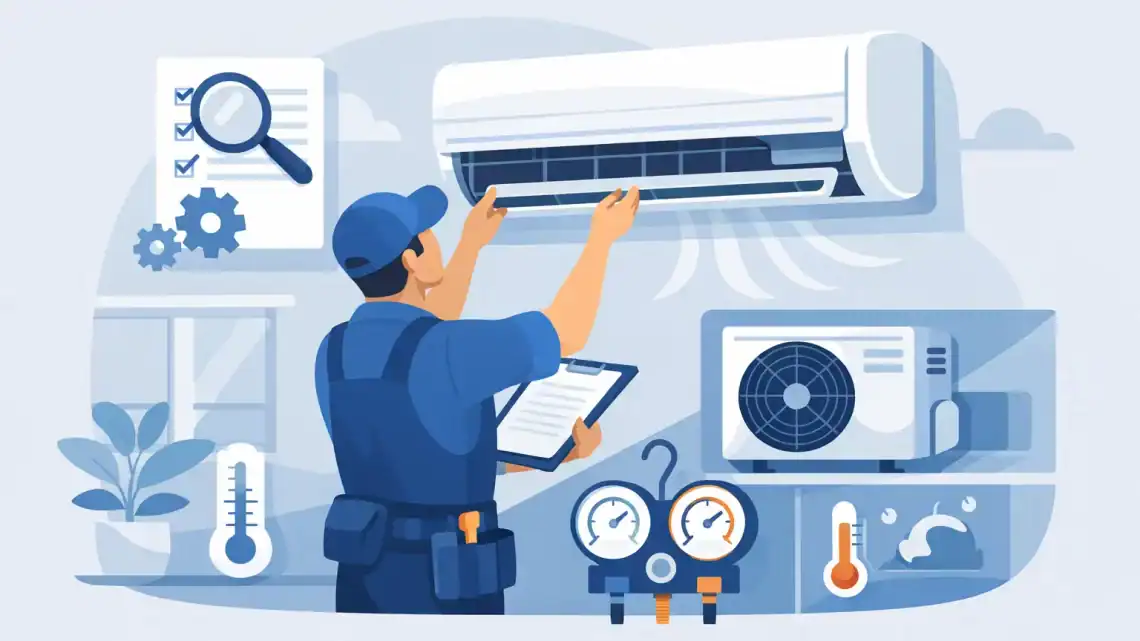
What a Free Aircon Inspection Should Include
24/07/2026When one bedroom is warm, the living room unit drips, or your aircon runs all night without properly cooling the flat, guessing is expensive. A free aircon inspection gives you a chance to find out what is actually wrong before agreeing to a repair, chemical service, gas top-up, or replacement.
The useful word is inspection. It should not be a rushed look at the remote control followed by a vague recommendation. A proper visit checks the system, explains the likely cause in plain language, and gives you a clear next step. You should know what is urgent, what can wait, and what the work will cost before anything begins.
What a free aircon inspection is for
Air-conditioning faults often look alike from the outside. Weak cooling may be caused by a dirty filter, a blocked drainage pipe, low refrigerant, a worn fan motor, a faulty sensor, or an issue with the outdoor condenser. Water leaking from a wall-mounted unit may be a simple drain blockage, but it can also point to poor insulation, an incorrect installation angle, or a cracked drain tray.
That is why a technician should diagnose first and sell later. The purpose of an inspection is to narrow down the fault without making you pay a transport or labour charge simply to ask for help. It is particularly valuable for System 2 to System 5 homes, where one outdoor unit supports several indoor units. A problem in one part of the system can affect comfort across several rooms.
For landlords and property managers, an inspection also creates a sensible record of the issue before authorising work. For a café, shop, or food-related premises, it helps avoid a small cooling problem becoming an urgent operational interruption.
What should be checked during an aircon inspection?
The exact checks depend on the symptom and system type. A technician cannot always confirm every fault without testing, dismantling, or carrying out repair work. Still, a thorough initial assessment should cover the basics that reveal where the problem is likely to be.
Cooling performance and airflow
The technician should ask which rooms are affected, when the issue started, and whether the unit cools poorly all the time or only after running for a while. They should check the selected mode and temperature, feel or measure the discharge air, and assess airflow from the indoor fan.
Restricted airflow is common in homes with dusty filters, dirty fan coils, or blower wheels carrying a build-up of grime. It can make the aircon feel weak, increase power use, and place extra strain on components. Yet cleaning is not automatically the answer. If airflow is normal but the air is not cold, the fault may lie elsewhere.
Drainage, leaks and indoor-unit condition
Water on the floor is never something to ignore, especially near sockets, furnishings, or false ceilings. An inspection should look for signs of a blocked drain line, overflowing tray, condensation on pipe insulation, and water marks around the indoor unit.
The technician may also check whether the unit is mounted level and whether the drain route has a poor fall. These details matter because repeated leaking can damage paintwork, cabinetry, and ceilings. A quick drain flush may solve a straightforward blockage, while recurring leaks need a closer look at the installation and the condition of the parts.
Outdoor condenser and refrigerant circuit
The outdoor unit does much of the hard work, so its condition matters. The inspection should consider whether the condenser is running, whether its fan operates normally, and whether there are unusual sounds, heavy dirt build-up, vibration, or visible damage.
If refrigerant is suspected, the technician should not simply recommend a gas top-up as a routine fix. Refrigerant does not get used up like fuel. Low gas often suggests a leak, and topping it up without finding the cause can provide only temporary cooling. In some cases, a pressure test or further diagnostic work is needed before the source can be confirmed.
Electrical controls and error signs
Modern inverter units rely on sensors, circuit boards, communication wiring, and control settings. A blinking light, error code, intermittent shutdown, or unit that trips the power supply may point to an electrical or electronic fault rather than a cleaning issue.
A good technician checks the visible wiring condition, power supply behaviour, and any fault indication available on the unit. For safety, damaged cables, burning smells, repeated tripping, or water near electrical connections should be treated as urgent. Switch the unit off and arrange professional help rather than repeatedly resetting it.
The questions a technician should ask you
Your answers can shorten the diagnostic process. Before the visit, think about whether the problem affects one indoor unit or all of them, whether it is worse at certain times of day, and whether there has been leaking, noise, ice formation, odour, or a recent power trip.
It also helps to say when the system was last serviced and whether it has been repaired before. A unit that has needed several gas top-ups, for example, deserves a different conversation from one that has simply missed regular cleaning. If you live in a condominium, keep any access requirements for the outdoor ledge in mind so the technician can inspect safely and without delay.
What happens after the inspection?
The outcome should be a recommendation, not a pressure sale. In many cases, the answer is straightforward: general servicing for dirty components, a drainage treatment for a blockage, or a specific replacement part for a failed component. In others, the technician may advise chemical servicing because contamination is heavy, or further testing because the fault cannot be confirmed from an initial check alone.
For older systems, repair versus replacement deserves an honest discussion. Replacing a single part can be the sensible lower-cost choice when the system is otherwise reliable. However, if repairs are recurring, energy bills are rising, parts are hard to obtain, or several units are approaching the end of their working life, a new inverter system may offer better value over time.
The recommendation should state what work is proposed, why it is needed, and the price before work begins. Ask whether the quoted price includes parts, labour, transport, and any warranty. If a repair has limits – for example, because a leak location is not yet confirmed – those limits should be explained clearly.
Free does not mean careless or incomplete
A no-obligation inspection is useful only when it respects your home and your decision. The technician should arrive within the agreed arrangement where possible, protect the work area, communicate clearly, and leave it tidy. You should not feel rushed into approving work because someone has already travelled to your property.
At the same time, free inspection does not mean that every technical test or repair is free. Chemical cleaning, refrigerant testing, replacement components, and complex fault tracing require time and materials. The fair approach is to separate the initial assessment from chargeable work and obtain your agreement first.
CoolServe’s approach is simple: diagnose the root cause, quote transparently, and let you decide. That matters when the choice could be a modest service today or a larger repair that protects the system from further damage.
When to book an inspection rather than wait
Do not wait for a complete breakdown if your aircon has started cooling unevenly, leaking, making new noises, producing a persistent smell, or using noticeably more electricity. Early attention can prevent water damage and reduce the chance of a small component fault affecting the compressor.
If the unit is still cooling but performance has slipped gradually, arranging an inspection before the hottest, busiest period is often less stressful than waiting until every room feels uncomfortable. For homes with regular servicing, it is also a useful way to investigate a specific fault without assuming routine maintenance will solve it.
A good inspection leaves you with something more valuable than a quick verdict: a clear explanation of what your aircon needs next, what it can safely wait for, and what you are paying for if you choose to proceed.