
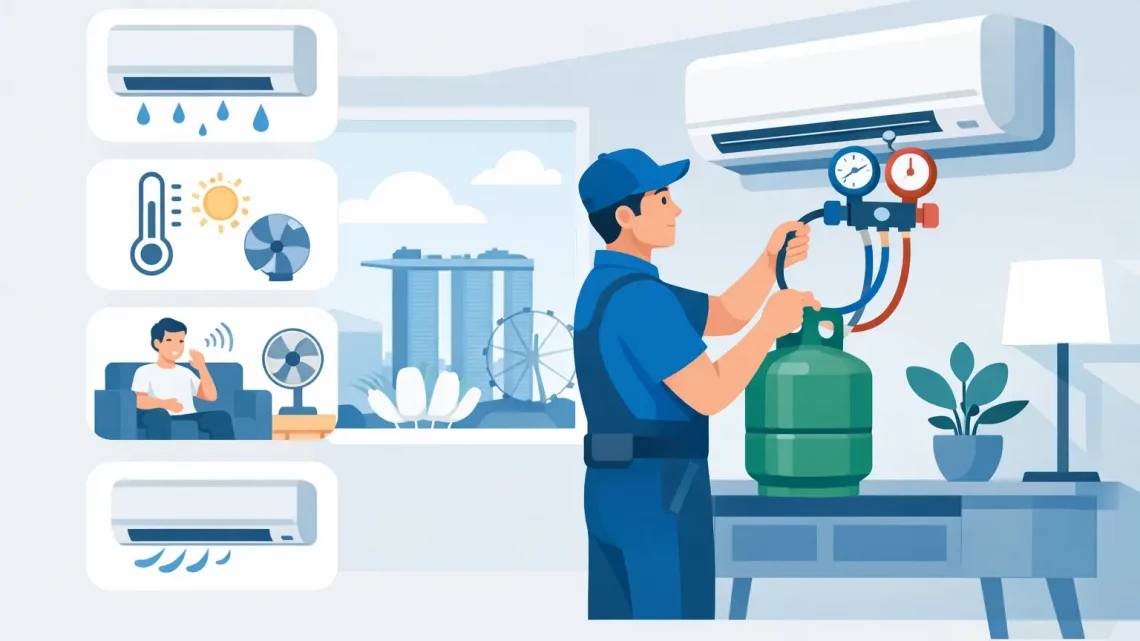
Aircon Gas Top Up Signs Singapore Homes Should Know
27/07/2026Your aircon used to cool the room within minutes. Now it runs for an hour, the air feels merely cool, and your electricity bill is climbing. An aircon gas top-up may be part of the answer, but it should never be the first assumption. Air-conditioning gas does not get used up like petrol. If the refrigerant level is low, there is usually a leak or an installation fault that needs attention.
For Singapore homes, where air-conditioning often runs nightly and across several rooms, getting the diagnosis right matters. A quick refill without finding the cause can bring temporary relief, then leave you facing the same warm room a few weeks later.
What aircon gas actually does
The gas in your air-conditioning system is refrigerant. It travels through sealed copper pipes between the indoor fan coil and outdoor condenser, carrying heat out of your room. Without the correct refrigerant charge, the system cannot absorb and release heat efficiently.
Modern systems commonly use refrigerants such as R32 or R410A. The correct type and quantity depend on the make, model and pipe length of your unit. These refrigerants are not interchangeable. Using the wrong gas, mixing gases, or adding an unmeasured amount can reduce cooling performance and may damage the compressor.
A properly installed, leak-free system should not need routine gas refills. That is why a technician should treat low gas as a symptom to investigate, not simply a product to sell.
Signs an aircon gas top-up may be needed
Weak cooling is the sign most people notice first, especially when one room feels warmer than the others despite using the same temperature setting. However, weak cooling alone does not prove low gas. Dirty filters, a clogged indoor coil, a failing fan motor, a faulty sensor, or an undersized unit can cause similar trouble.
Low refrigerant becomes more likely when weak cooling appears alongside other signs. The indoor unit may take much longer to cool the room, ice may form on the evaporator coil or copper piping, and you may hear a faint hissing sound near the pipes. In some cases, the outdoor condenser runs for long periods without reaching the set temperature.
For multi-split systems, the pattern is useful. If only one fan coil has poor cooling while the others are normal, the issue may be local to that indoor unit, its piping, valve or coil. If every room is underperforming, the shared outdoor unit, refrigerant charge, electrical supply or overall system capacity needs closer checking.
Do not rely on the airflow alone. A unit can blow strongly yet still deliver air that is not cold enough. Likewise, water dripping from the fan coil usually points to a drainage or cleaning issue, not necessarily a gas problem.
Why refrigerant levels become low
Refrigerant loss normally comes from a leak. The leak may be at a flare joint, a worn valve, a corroded coil, or a damaged section of pipework. Older systems can develop corrosion over time, particularly where moisture and contaminants affect the coil. Newer installations may leak if pipe joints were not tightened, pressure-tested or insulated correctly.
A very slow leak can be frustrating because the system may seem fine after a top-up, then gradually lose cooling again. A larger leak can cause a noticeable drop in performance within days or weeks. Either way, repeatedly adding gas without repair costs more over time and puts extra strain on the system.
There are exceptions. During an installation, relocation, major repair or replacement of damaged pipework, a system may legitimately require refrigerant to be recovered, measured and recharged. This is not a routine top-up. It is part of returning the system to the manufacturer’s specified operating condition.
What a proper diagnosis should include
A reliable gas service starts with inspection, not a charging hose. The technician should first check the basics: filter condition, indoor coil cleanliness, drainage, fan operation, temperature difference and the outdoor condenser’s condition. These checks can identify common faults that do not require refrigerant work.
If low gas is suspected, the next step is to assess operating pressures and temperatures using the correct equipment for the refrigerant type. A proper leak check may involve inspecting joints and valves, using electronic detection equipment, applying leak-detection solution, or pressure-testing the pipework where necessary.
The exact method depends on the system and access. Concealed piping in a renovated flat can make the investigation more involved than exposed trunking in a utility area. A responsible technician should explain what has been found, what can be repaired now, and where further testing is needed before recommending a recharge.
At COOLSERVE, the aim is to diagnose the root cause before proposing a repair. That means you can make a clearer decision between repairing a leak, carrying out a full chemical service where the coils are badly soiled, or considering replacement if an ageing system has repeated faults.
Is a top-up enough, or is repair necessary?
An aircon gas top-up is appropriate after a leak has been repaired, or when testing confirms that a small loss has occurred and the system can be returned to its correct charge. The technician should use the right refrigerant and charge the system accurately, rather than adding gas until the air merely feels colder.
If the leak is accessible at a flare joint or service valve, repair may be straightforward. The system should then be tested before refrigerant is added. If the leak is inside a corroded coil, the practical choice depends on the unit’s age, condition and repair cost. Replacing an indoor fan coil can make sense for a relatively new multi-split system, while replacing the wider system may be better value when several components are old or unreliable.
There is no honest one-size-fits-all answer. A five-year-old inverter unit with one repairable leak deserves a different recommendation from a 12-year-old system that has needed several gas top-ups, has a noisy compressor and no longer cools consistently.
Avoid these costly shortcuts
Be cautious of anyone who promises to top up gas without inspecting the unit or asking about its refrigerant type. The low price may look attractive, but it can hide an incomplete job. Refrigerant comes with many grades and quality. Only reputable comapany like us use the best quality refrigerant. Refrigerant must be handled by trained and cerifified professionals using suitable gauges, recovery equipment and safety procedures.
Do not attempt a DIY refill kit. Air-conditioning systems operate under pressure, and incorrect handling can cause injury, release refrigerant, contaminate the system or damage costly components. A compressor replacement is far more expensive than a proper diagnostic visit.
It is also worth asking a simple question before authorising work: “What caused the gas to be low?” If the answer is unclear, ask what checks were carried out and whether a leak repair is included. Clear explanations and transparent pricing are reasonable expectations, not extras.
Keeping your system efficient after repair
Once the refrigerant issue has been resolved, regular maintenance helps protect cooling performance. Clean filters every few weeks if you use the aircon frequently, keep the area around the outdoor condenser clear, and arrange servicing at intervals that match how heavily the system is used. Homes that run several units every night usually need more attention than a guest room switched on only occasionally.
Set a sensible temperature as well. Running the unit at an extremely low setting will not cool the room faster, but it can keep the compressor working longer. Good insulation, closed windows and clean coils all help the aircon reach the selected temperature with less effort.
If your aircon is no longer cooling as it should, do not settle for a temporary blast of gas. Ask for the cause, the repair options and the expected outcome. The right fix should leave your home properly cool and give you confidence that the problem has been treated, not postponed.